
Introduction
There are several ways of conceiving heritage conservation. For the purpose of this paper, we need to start from the premise that what we call “heritage” is a dynamic, evolving reality, and that a historic district such as “Old Québec” can undergo structuring transformations rooted in a process of heritage conservation.
In Old Québec, the process of conservation —also referred to “patrimonialization”—has not received the attention it deserves. This paper aims to shed light on the process of functional requalification has undergone by Old Québec since the 1950s, within the broader context of its transformation into a historic district. It is based on discourse analysis (Berthold, 2013), supported by a diversifie body of documentation, including primary sources, such as archival documents, press reviews, geospatial and land-use data, and official reports. It is complemented by a body of scholarly literature devoted to Old Québec since the 1970s.
First, we explain the sociohistorical process that led to the creation of Old Québec, starting in the 1950s. Then, we highlight the role played by tourism and the real-estate economy —includingdevelopers—in this process.
Turning the Champlain District into a historic district
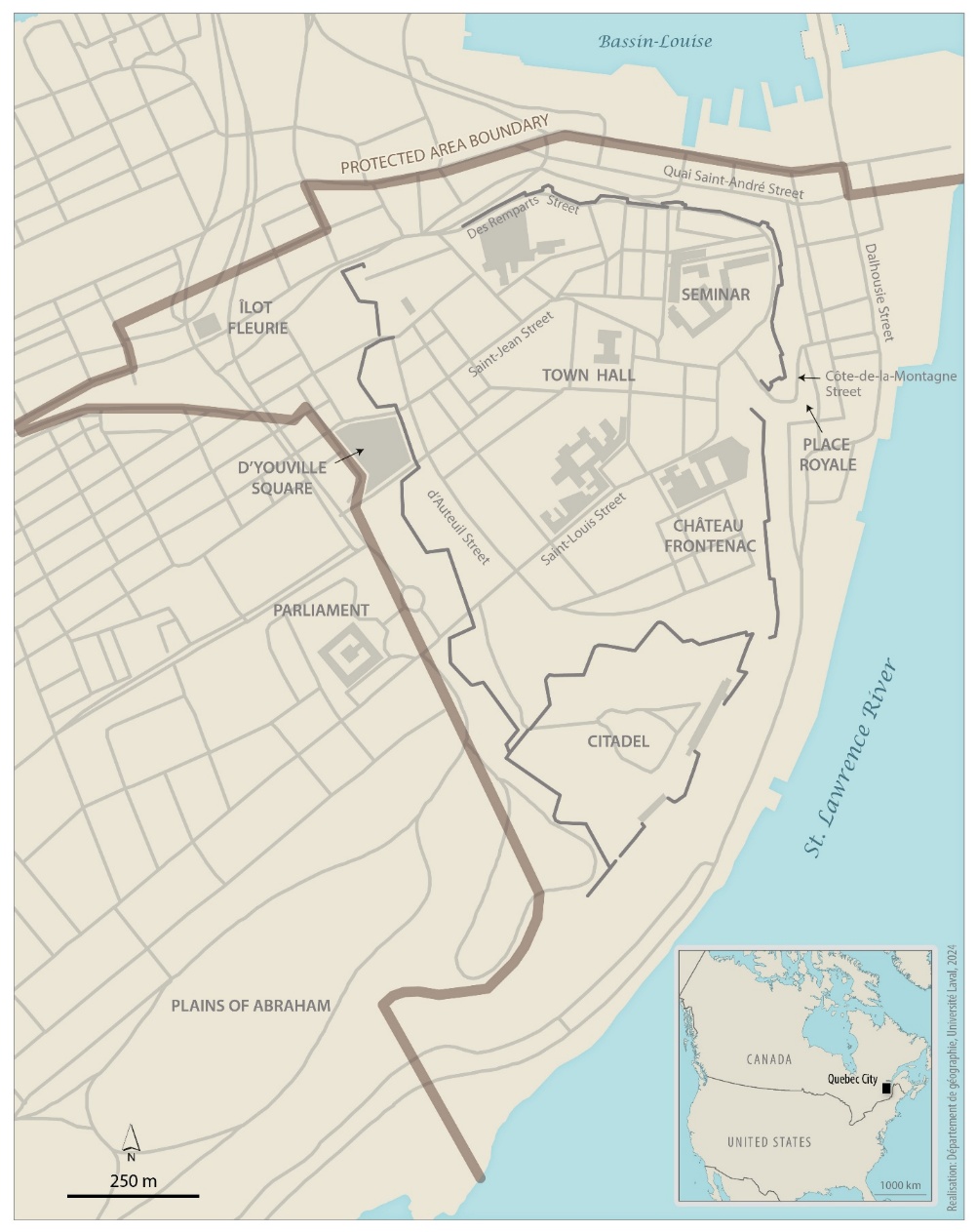
At the turn of the 1950s, the area now known as “Old Québec” was referred to as the Champlain District. Named after the city’s main colonial founder, Champlain was one of the first areas to be settled, beginning in the early 17th century. It covers an area of some 135 hectares, which is essentially divided into two parts.
Figure 1. Boundaries of Old Québec
Reproduced with modifications from Devaux et al., 2018, p. 287. Licence CC-BY-4.0.
First, there is the intramural sector, enclosed by a system of fortifications that have been extensively reworked since the colonial period. This area, which was once home to the 19th-century business bourgeoisie, is characterized by buildings with eclectic architecture, featuring two- or three-story structures, gabled roofs, and firewalls. Most of the buildings were built around 1845, making it the oldest housing stock in Québec City.
Second, a large part of the Champlain District extended into the Lower Town, along a southeast-northwest axis that runs from the base of Cap Diamant (beneath what is now Château Frontenac) to the Gare du Palais area. This area was partly formed by various land reclamation operations at the turn of the 19th century, aimed at intensifying port activities. The architecture found in the Lower Town is eclectic and neoclassical, featuring three- or four-story buildings, many used for residential purposes, constructed of brick and topped with mansard roofs. Most of the housing stock was built around 1866, making it older than that of other Québec City neighborhoods, but more recent than the intramural sector.
Socioeconomically, the Champlain District of the late 1950s was a mixed neighborhood whose demographics—at around 11,000 people—had been artificially inflated in the wake of the war effort: the Upper Town was home to many military industries intended to support the Allies. Overall, the district’s population was family-oriented and relied on a diversified commercial base that included many so-called convenience stores selling items such as food and clothing. The area was also home to administrative offices (Berthold, 2012; Vallières et al., 2008).
Context – The proclamation and transformation of Old Québec
In the early 1960s, two major factors fundamentally changed the Champlain District. First, the early 1960s marked the emergence of a structured urban planning approach that sought, in part, to redefine the Champlain district as as historic district (Berthold, 2012). Secondly, in 1963, in the wake of the revision to the Historic Monuments Act that allowed for the creation of historic sites, the Historic District of Old Québec was proclaimed. This proclamation was a form of recognition and a political commitment to the future conservation of the area, which was definiedby a precise perimeter of 135 hectares. Second,
In 1956, a team of architects and urban planners led by Jacques Gréber submitted their report Projet d’aménagement de Québec et de sa région (Gréber et al., 1956). Then, in 1961-1962, Jean-Marie Martin, Dean of the Faculty of Social Sciences at Université Laval, submitted a comprehensive report entitled Le logement à Québec. What is noteworthy about these two documents is that they clearly recognize the historic character of the Champlain District. According to these documents, the natural consequence—which would guide the spirit of urban planning interventions until the late 1970s —was that the rediscovery of the “Historic Québec” implied both urban redevelopment as outlined in the Gréber report and the transformation of the housing stock to promote the relocation of family housing with the Martin report. Their content is therefore clearly linked to a conceptual framework that favors urban renewal (Berthold, 2012; Caron, 1996; Gréber et al., 1956; Mercier & Mascolo, 1995).
Changes in the functions of Old Québec
In 1970, the City of Québec released its Concept général de réaménagement du Vieux-Québec. This document marked an important step in the functional transformation of Old Québec. This redefinition is part of a dual process of restoration and redevelopment. Restoration, which aims to modernize the district, involves building repairs and some demolition. Redevelopment, on the other hand, is more radical, involving demolition, land reallocation and infrastructure modification (Comité de rénovation et de mise en valeur du Vieux-Québec, 1970).
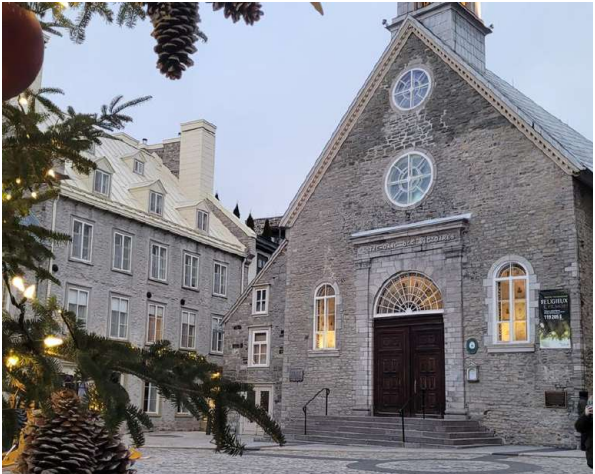
The restoration of Place Royale, located in the Lower Town, facing the St. Lawrence River, was the first significant milestone in the functional transformation of Old Québec as a historic district. Until the early 1970s, the project to restore Place Royale was marked by two important elements. First, there was a belief that the square itself possessed historical significance, based in part on the presence of a bust of Louis XIV, which the municipal authorities had installed in the 1930s, and on the presence of Notre-Dame-des-Victoires church, which had become part of historical narratives from the second half of the 19th century (Berthold, 2007).
Figure 2. Place Royale
© Kiw Pawliw.
Second, there was a belief that rediscovering the historic significance of Place Royale would largely require the functional redefinition of buildings and sites. The architect and urban planner André Robitaille undoubtedly went further in this direction. He considered that preserving the historic character of Old Québec involved “changing [the district] functions and finding new ones”. Inspired by the Martin report, he considered that Place Royale should be the object of “integral restoration”, which would exclude both family housing and residential use altogether. In sum, this restoration took the form of a reconstruction project which, over the course of the 1970s, resulted in one-third of the buildings in the area demolished and rebuilt, while two-thirds restored (Berthold, 2012).
The importance of the Place Royale reconstruction project does not lie in the continuation of restoration approaches, since by the end of the 1970s, ministerial and municipal authorities were stated that they no longer wished to pursue the conservation of Old Québec’s urban heritage in such a drastic way. In the 1980s, the functional requalification of Old Québec continued, in a much more moderate way, through the redevelopment of major public squares such as Place d’Armes and Place d'Youville, both located in the Upper Town (Berthold, 2012).
At the turn of the 1980s, public authorities decided to extend the heritage program for Old Québec to include private property. The aim was to integrate private property into the ‘heritage system’ (Berthold & Mercier, 2015). In 1979, the Division of Old Quebec and Heritage was created in the wake of the Place Royale project and in anticipation of Québec City’s eventual inclusion on the UNESCOWorld Heritage List. This division of the city's urban planning department was given the practical mandate of “guiding the actions of public and private stakeholders in Old Québec”. In this context, two of the most important programs for private restoration were established in the 1980s: “PARSIA” and “Maître-d'oeuvre” (Service de l'urbanisme, division du Vieux-Québec et du patrimoine, 1982).
PARSIA addressed the issue of burned buildings by subsidizing owners for part of the difference between the cost of reconstruction and the market value of their property. Maître-d’oeuvre aimed to stimulate residential restoration by subsidizing up to 40% of the cost of major work on the building envelope. The strong success of these two programs was a major factor in the institutionalization of home restoration practices in Old Québec (Service de l’urbanisme, division du Vieux-Québec et du patrimoine, 1982).
The functional redevelopment of Old Québec
Linking private heritage restoration to the restoration of public squares had a remarkable ‘leverage effect’ on the functional transformationn of Old Québec under the heritage regime. This redefinition is based not only on the standardization and normalization of restoration approaches, butalso on a profound transformation of urban functions, starting with the residential function. Overall, the resident population declined from 5,200 people in 2006 to 4,780 people in 20211. The drop in population was particularly noticeable in the intramural sector. The socioeconomic status of Old Québec also changed just as dramatically: by 2021, socioeconomically disadvantaged residents were largely confined to the northern portion of rue St-Jean, signaling a relatively widespread rise in wealth levels. Regarding the real estate market, in the 2010s, a large portion of the residential stock had been converted into condominiums, and a large part was owned by non-residents. Approximately one-thrid of the units—600 out of 1,800—were owned by non-residents. Lastly, “love of heritage” had become the primary reason for attracting and retaining the residential population in Old Québec (Berthold & Mercier, 2015).
Tourism, economy and real estate activities
The crowning achievement of the functional redefinition of Old Québec is also based on major economic transformations, in tourism on the one hand, and in the real estate sector and business on the other.
Tourism
At the end of the 1950s, or more precisely in 1957, the Champlain District welcomed a total of 650,000 to 700,000 foreign tourists, as measured by automobile traffic. Tourists who visited the district generally followed a set route. In the Upper Town (also known as the Haute-Ville), they followed rue Saint-Jean as well as nearby streets. When they ventured into the Lower Town (also known as “Basse-Ville”), it was usually to contemplate the Notre-Dame des Victoires Church, designated as a historic monument and restored in 1929. In the 1950s, tourists were on the threshold of what is now known as mass tourism, even if they possessed fewer technical resources (Paré, 1957).
In the late 1970s, following the work on Place Royale and the surrounding area, the Lower Town tourist circuit expanded. Place Royale and Petit-Champlain became increasingly popular for tourists. The continued functional redefinition of Old Québec in the 1980s and 1990s, for which Québec City’s inclusion on UNESCO World Heritage List in 1985 was an important milestone, led toa steady increase in tourist numbers (Berthold, 2016).
In 2004, the number of visitors to Old Québec was estimated at 2,800,000. Beyond simple visitor numbers, this phenomenon is significant insofar as the tourist world is a major consumer of, and a key participant in the heritage transformation of the Champlain District (Office du tourisme de Québec, 2010). One of the corollaries of this pressure is the closure of local convenience stores in favor of stores that align with the tourist economy. For instance, in 1969, out of a total of 334 commercial establishments, 37 were in the food sector, representing 20.3% of Old Québec’s commercial structure. In 2024, the food sector accounted for a total of 23 establishments, including convenience stores, or just over 6% of the district’s main types of bunisnesses2.
Economy and real estate sector
It took until the late 1990s, and especially the 2000s, for the heritage designation of Old Québec to have a tangible effect on the real estate economy. In the late 1970s, in the wake of growing attention to private heritage restoration, the Québec City Chamber of Commerce succeeded in creating a fund to purchase six properties in the historic district for heritage restoration. Endowed with one million dollars, the revival fund, as it was then called, had the objective of enabling the City of Québec to promote private restoration and eventually had a broader impact. Once the properties had been restored, they were put back up on the real estate market, but they were unable to cover the many costs associated with heritage restoration. The conclusion was clear: the injection of funds into a heritage property did not translate into a substantial real estate premium (Chambre de commerce, n.d.).
But the dynamics of the 1990s were to transform this reality. Between 1995 and 2010, restoration programs led to the injection of approximately $100 million in private investment (Berthold, 2016). The decade of the 2000s, which saw an increase in the average annual growth in real estate values in Québec City metropolitan area contributed significantly to affirming the “heritage premium.” For example, in 2011, the price of condominium units located within Old Québec was 22% higher than for comparable units located in the other boroughs of Québec City (Berthold & Harvey, 2013).
The emergence of a heritage real estate market, now a reality in contrast to the 1970s, fully reflects Old Québec’s new heritage role. It has also given rise to diversified investment dynamics. For instance, non-permanently inhabited properties belong to people who live in the Québec City area.
During the 1980s and 1990s, the ongoing restoration of both the public and private components of Old Québec attracted a growing number of real estate developers. We still know very little about this dynamic, but we do know that, since then, there has been a tendency for developers to specialize in specific sectors of Old Québec, according to their objectives, expertise, and networks. Groupe Norplex Inc. comes to mind (Norplex, n.d.). This joint-stock company carried out numerous rehabilitation and new construction projects in the northwestern portion of the Lower Town between 1999 and 2017, basing its interventions on the “prestige” brought about by the historic environment and the quality of the view over the Old Port sector and the Laurentian foothills that dominate it.
The research project we are currently carrying out as part of the joint initiative between French and Québec colleagues is designed to provide a better understanding of the specific profiles and actions of heritage entrepreneurs.
Conclusion
The primary aim of this paper was to present the main factors that led to the functional redefinition of Old Québec and transformed it into a historic district.
The transformations that have taken place in what is now known as “Old Québec” are far from trivial: the spectacular conversion of public squares and private real estate through the enhancement of heritage features, the profound transformations in the nature of residential function, a notable increase in tourist numbers and in the tourism economy, the slow (but solid) emergence of a real estate market based on the heritage premium, among others.
It should be noted that “Old Québec” has undergone a major functional redefinition, at the heart of which lies a process of “patrimonialization”.
*
|
Author’s disclosure of the use of generative AI |
|||
|
YES |
NO |
Details |
|
|
Writing and argumentation |
X |
Use not permitted in Cahiers ESPI2R |
|
|
Information retrieval and literature review |
X |
||
|
Rephrasing |
X |
||
|
Spelling and/or grammar correction |
X |
||
|
Summarization and/or keyword generation |
X |
||
|
Image and video generation |
X |
Use not permitted in Cahiers ESPI2R |
|
|
Coding and programming |
X |
||