
Context
In the face of climate change and with its Mediterranean climate, the city of Marseille and its densely built historic center are likely to be increasingly confronted with risks such as heat waves, drought, and heavy rainfall in the coming years (Gaucher et al., 2020). Marseille’s historic housing stock also faces severe deterioration, especially in working-class areas of the first three districts. These issues have been highlighted since 2018 and the collapse of two buildings in the Noailles district, which caused the deaths of eight residents. The wave of mass evacuations that followed, affecting over 1,200 buildings and between 7,000 and 11,000 people over the following six-year period (Dorier, 2024), and the strong citizen reaction to these events have put run-down housing back on the public agenda in the historic city centre. Today Marseille’s city centre is the focus of an urban redevelopment project (projet partenarial d’aménagement) voted in 2019, which directly resulted from the 2018 building collapse and the crisis that followed. The project aims to tackle run-down housing, while also integrating climate change issues, notably through the restoration of vernacular architecture.
This paper draws on the European research project SustHerit1 which considers the sustainable adaptation and transformation of historic housing in the context of climate change in Marseille, Vienna, Prague, Glasgow, and Zurich. It stems from the second work package of the project, which aimed to determine how climate change, heritage preservation and housing policies interact in the historic neighborhoods of these different cities. In this paper, we will examine more closely how renovation policies of Marseille’s historic housing stock balance social, environmental, and heritage preservation issues, and reflect on the “lever” effect stakeholders are betting on, opening future research perspectives. This paper draws on content analysis of institutional documents linked to urban policies and planning projects, as well as semi-structured interviews with planners and project stakeholders involved in urban planning, housing, and heritage preservation including the city and metropolitan planning services (Urban Regeneration, Housing, Urban planning), local planning companies (société publique locale d’aménagement d’intérêt national [SPLA-IN], Euroméditerranée) and the urban planning agency (agence d’urbanisme de l’agglomération marseillaise [AGAM]), as well as heritage preservation officials, social housing organizations, and architects involved in the urban regeneration plan.
We will first discuss how the urban project develops an intervention model based on “demonstrator blocks” in line with neoliberal urban production processes. We will then look more closely at the “property recycling” approach to identify how stakeholders negotiate environmental, social, and heritage preservation objectives. We will conclude by analyzing some of the stakes linked to the expected “lever” effect of these measures, outlining avenues for future research.
Figure 1. Marseille, Aubagne Street, 2026
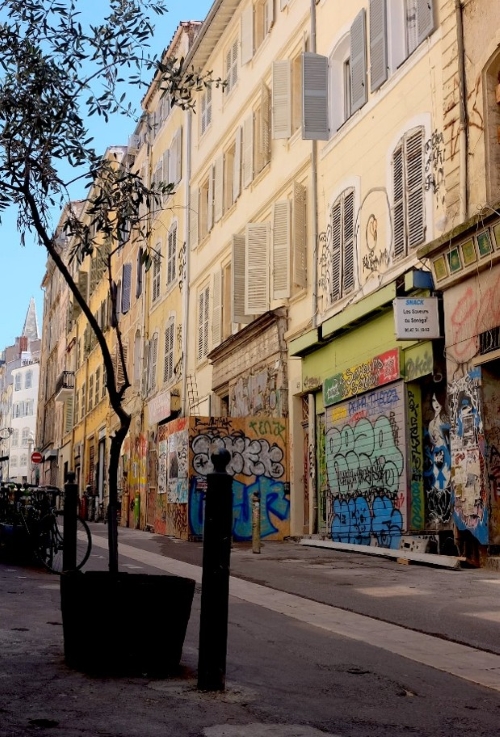
Ongoing work on a building closed following a dangerous-building order.
© Margot Bergerand.
“Demonstrator blocks”: neoliberal urban production in the face of uncertainty and budget austerity
In Marseille’s city centre, the main housing policy relies on an urban regeneration project which encompasses 1,000 hectares.
Figure 2. The SPLA-IN’s 5 “demonstrator blocks”
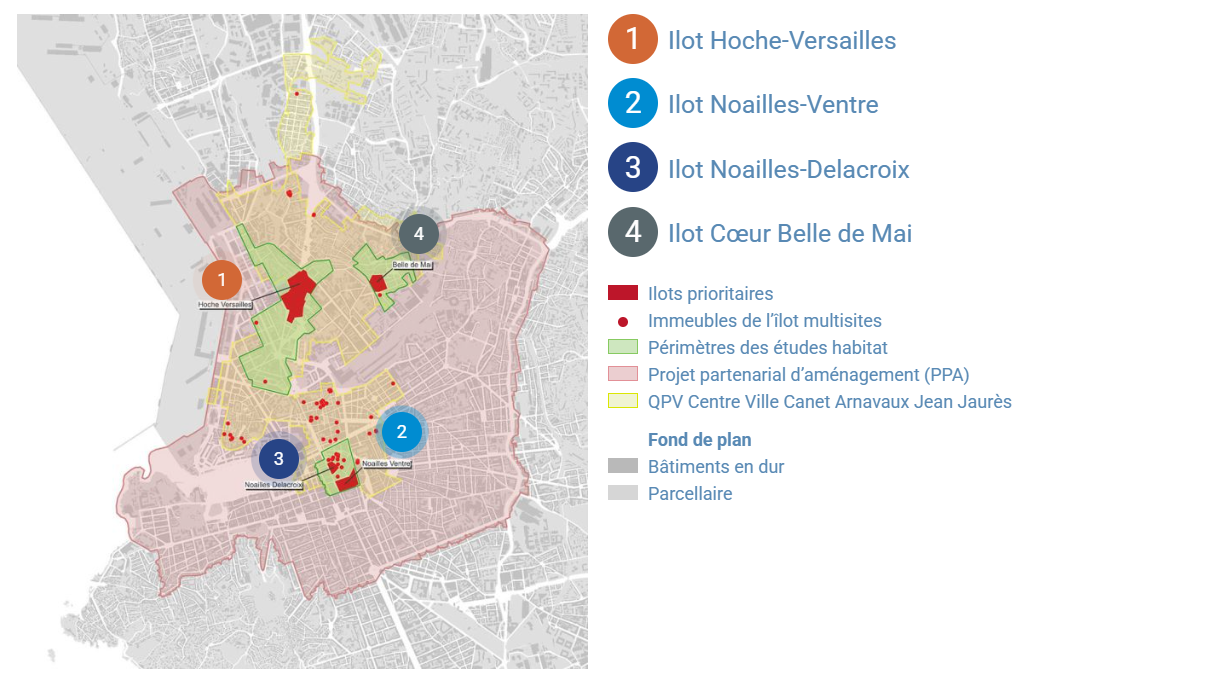
Four blocks have delineated boundaries, the fifth “multisite block” is composed of isolated buildings.
© SPLA-IN AMP, 2022.
The project aims to retrofit the historic centre to tackle substandard housing issues. It relies in particular on a new public player, a public development company of national interest (SPLA-IN), created in 2020, whose activities are concentrated in five “demonstrator blocks” designed to kick-start a regeneration wave in the historic city centre over the next ten years. This type of demonstrator approach, in line with neoliberal urban production processes, has become widespread in urban planning in response to budget austerity. Faced with limited financial resources, local authorities tend to concentrate their interventions in specific areas and increasingly involve private actors. This approach also allows stakeholders to experiment in order to address uncertain contexts where few formalized solutions exist and public resources remain limited given the stakes (Béal et al., 2015), such as adapting the housing stock and urban environments to the effects of climate change or such as kick-starting major renovations of private, run-down housing after years of insufficient or ineffective policies.
The project seeks to address, simultaneously, building safety as well as the social, environmental, and heritage challenges facing this housing stock. The SPLA-IN’s organizational structure, bringing together the Metropolis, the State, and the City as shareholders, creates a common instrument for these local authorities which share planning powers but are politically opposed to each other. Metropolitan and Municipal authorities are showcasing their collaboration in this context, agreeing on a project that aims to tackle substandard housing in the center of Marseille by refurbishing and creating social housing in a number of privately owned run-down buildings and by encouraging private landlords to renovate their properties. The project relies on exceptional funding from government agencies such as the Agence nationale de la rénovation urbaine (ANRU) and the Agence nationale de l’habitat (ANAH). The State’s role as a major financial contributor through these funds, and as a shareholder in the SPLA-IN is consistent with the consolidation of a “neo-liberal model of remote government of territories” (Epstein, 2005, p. 12).
The SPLA-IN’s interventions are concentrated in four areas in the working-class and impoverished neighborhoods of Noailles, Belle de Mai and Saint Lazare-Villette, some of which are also subject to very uneven and often incomplete gentrification processes (Baby-Collin & Bouillon, 2017). These intervention areas were initially named “priority blocks”; they are now mainly referred to as “demonstrator blocks”. As the policy developed, the idea that private actors should be involved was progressively reinforced. Indeed, public authorities rapidly opted for this approach, due to real estate costs, ownership fragmentation and the little leeway given by existing public policies to generalize more interventionist procedures such as expropriation. Interestingly, outside of these “priority blocks” a fifth “multi-site block” was also created, as the SPLA-IN recovered ownership of several vacant buildings throughout the city center, which were already publicly owned as a result of substandard housing policies implemented over the past 20 years. This simplified access to property allows the SPLA-IN to accelerate relatively lengthy procedures and showcase a proactive approach on this politically sensitive issue2.
In these demonstrator blocks, the SPLA-IN relies on an intervention model that was, until then, rarely used in Marseille’s housing policies: “property recycling”. This intervention model implies the conversion of 180 run-down private housing buildings into social housing through public control of the land and resale to social housing organizations. These operations aim to produce social housing in 70% of rehabilitated buildings, in districts that particularly lack affordable housing, considering their social composition (Bouillon et al., 2017), but also pursue ANRU’s specific objectives of creating “social diversity” from the top down, by encouraging middle-class households to move into working-class neighborhoods (Miot, 2013). As it is deemed costly for public authorities, this intervention model is combined with more traditional means of action such as the redevelopment of public spaces and incentives for private landlords to carry out renovations. These policies therefore rely on and aim to activate a “lever” effect designed to set in motion a process of housing stock rehabilitation, that largely engages private actors. In this sense, Marseille’s city center regeneration project is not immune to the contradictions of urban policies intended to transform historic city centers, which, despite rhetoric about maintaining current residents, rely on “policies aimed at attracting both new households and real estate capital” (Miot, 2013, paragr. 69).
The demonstrator approach is also designed to provide a technical demonstration of the retrofitting potential of Marseille’s vernacular architecture. The SPLA-IN's intervention aims to showcase sustainable and best-practice regeneration of the historic center by developing a “Marseille three-window renovation model” highlighting this predominant architectural typology’s historic bioclimatic qualities.
Figure 3. “Marseille three-window renovation model”
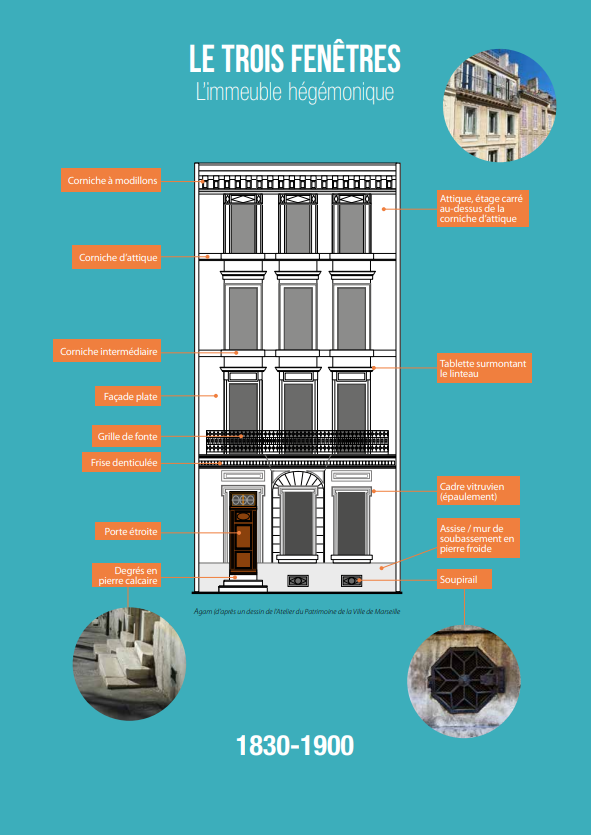
Reproduced from AGAM, 2024, p. 39.
The project also sets out strong ambitions in relation to health issues, reuse, the circular economy, geo-sourced materials, etc. The approach holds an experimental dimension, as it aims to test solutions that meet environmental, heritage preservation, and housing renovation objectives. It is also driven by a goal of replicability, designed to create a local culture and know-how, and to consolidate local supply chains. The aim is to structure a market for ordinary heritage rehabilitation which is currently considered to be an underdeveloped supply chain.
The demonstrator approach therefore combines two main objectives: producing exemplary projects, particularly with the support of social housing organizations, and structuring supply chains, markets, and private actors through a “leverage effect”.
The “property recycling model” – questioning urban production processes
Focusing first on the “property recycling” model, which relies on public intervention to transform previously privately owned, run-down historic buildings into social housing, we will examine how demonstrator approaches are implemented and negotiated among local stakeholders and how they interact with existing urban production processes. The “property recycling” model relies on collaboration with social housing providers, which are increasingly positioning themselves as partners in the fight against substandard housing. While a considerable share of social housing production in new construction is now delegated to private developers in France (Hincker Jourdheuil, 2019), the transformation of substandard historic housing is a field in which they can apply their expertise as direct developers. Indeed, the risks and costs associated with renovation work in this type of housing stock, particularly in areas where heritage preservation regulations apply, limit the appeal of this market for private developers. However, opening up this new field is not without challenges for social housing organizations, which are also constrained by their own profitability models and financing mechanisms. The implementation of this model also reveals some difficulties in aligning the environmental, heritage, and social ambitions outlined in the urban regeneration project.
For stakeholders, the first challenge is to control costs, as the operations must be economically viable; however, renovations of rundown housing are generally considered costly and risky. Given their demonstrative ambition and considering the public scrutiny they fall under, these operations benefit from significant public funding, however, they are also affected by “unforeseen events”3, such as rising construction costs or potential “surprises” associated with renovation, particularly given the level of deterioration of buildings. To address the uncertainties of renovation, the SPLA-IN and social landlords have implemented new working processes. For example, they developed a joint project management structure to share the financial risk in operations and to plan projects collaboratively through to their final use. The SPLA-IN is the project manager for the first part of the operation including land acquisition and structural construction work, the project is then sold at a fixed price to social housing providers, which take over for the second phase of renovations. This system provides social housing organizations with greater security as they are guaranteed a fixed purchase price and as they assume control of operations only after most risks linked to the renovation of substandard housing have been addressed.
The urban renovation project also showcases strong heritage preservation and environmental objectives, particularly in “property recycling” operations, which require negotiations and trade-offs between project stakeholders. For example, historically, the city center has received little heritage protection. Zoning restrictions were only introduced in the 1990s, but a new Site patrimonial remarquable perimeter was established in 2018, which encompasses a significant portion of the historic fabric and provides for the material preservation of buildings. Given these protections, the pressure to deliver fast results, and the sensitivity of some of its executives to heritage preservation issues, the company has opted to work closely with the State Architect (architecte des bâtiments de France), who must approve development projects in protected areas. There is consensus among stakeholders regarding the heritage value of vernacular architecture, certain original features of which should be restored (natural ventilation, through-apartments, breathable wall coverings). Synergies between heritage preservation and environmental performance are often highlighted as offering low-tech opportunities for building retrofits. Heritage preservation requirements can nevertheless sometimes disrupt the economic balance of operations. For example, the heritage preservation official’s requirement to preserve ceiling plasterwork in one project caused tensions between the SPLA-IN and social landlords as the associated renovation costs significantly jeopardized the balance of the operation. Another example concerns environmental objectives. As future managers, social landlords have an incentive to consider environmental performance issues. Reducing tenants' utility bills is, for example, a management strategy they can employ to ensure rent payments and overall housing affordability. However, the environmental ambitions of the project do not always align well with their financing logic. For example, the goal of restoring through-apartments—one of the original bioclimatic qualities of the buildings identified as “three window” units—leads social housing providers to produce larger homes than in their usual development standards, which challenges the financial balance of their operations, as they have to comply with low rent thresholds. Finally, the acquisition of small buildings in city centers means that social landlords, which are more accustomed to managing larger property portfolios need to change their strategies and management models.
The production of social housing in historic buildings therefore requires balancing technical, economic, and management issues. This entails trade-offs between economic viability, environmental performance, heritage preservation, and social objectives. The demonstrator model reflects a proactive approach by public authorities in some relatively limited areas of Marseille’s city center, where local authorities and the state are building the capacity to intervene directly in the housing supply and restore the bioclimatic qualities of vernacular architecture. The collective trial-and-error processes and power struggles that play out in land recycling projects shed light on how stakeholders negotiate heritage preservation, social issues and climate-related objectives in the historic housing stock. These developments are giving social housing providers a prominent role, while also shaking up their professional cultures and traditional economic models. These renewed forms of urban production are spreading beyond the scope of the SPLA-IN alone, as the city has, for example, launched similar calls for proposals for its own properties. However, these interventions have a limited scope, and standard public policy instruments remain ill-equipped to meet social, environmental and heritage preservation goals across the rest of the housing stock.
Betting on a “lever effect”— but to what end?
As public actors are limited in their ability to intervene directly by land prices, their financial capacity, and the relatively fragmented nature of private property ownership4, they are encouraged to rely on a “lever effect” and on incentives for private actors, who are expected to rehabilitate nearly 9,000 homes in the private housing stock in the coming years. Given the significance of building safety issues facing the historic housing stock, environmental objectives remain secondary in this area, demonstrating the difficulty of replicating the same level of ambition found in “property recycling operations” in the private sector. Incentives to private owners therefore focus on structural renovations to ensure long-term building safety. This raises the question of how demonstrator approaches can create territories of exception and how “ordinary” territories are dealt with (Ambrosino & Devisme, 2024; Chesnel & Devisme, 2020). Furthermore, this model implies public subsidies to private owners and public spending to regenerate public spaces, but it provides relatively few means to preserve housing affordability and tenant security in the private market. For example, the subsidies that can be granted to private landlords (subsidies at the level of the building as a whole or subsidies linked to energy renovation) are not necessarily associated with ‘social compensation’ obligations, i.e., a contractual system that requires landlords to rent the property at a set price and to tenants who meet an income limit. Public action provides few tools and resources to ensure comprehensive renovations that consider both environmental issues and the long-term affordability of the housing stock, particularly in a context of rising rents and property prices that has affected Marseille since 2018.
Conclusion
These observations encourage future investigation into this expected “lever effect”. Indeed, urban production relies on private-sector actors, such as private landlords, in these neighborhoods, where the private rental market dominates. In low-end segments of the rental market, strategies focused on high rental yields tend to prevail over real estate value enhancement through investment (Bergerand, 2024), raising new questions in the case of renewed public investment in these areas. For instance, how do the rent extraction strategies of existing—and potentially new—actors unfold in interaction with this context and with the urban and real estate transformations underway?
Moreover, the private housing market is currently only loosely regulated in Marseille, and residents are exposed to rising rent and property prices, driven by different forms of urban capital circulations linked, among others, to the gentrification, studentification and touristification. Beyond the debates on the reality of the gentrification phenomenon in Marseille (Baby-Collin & Bouillon, 2017; Jourdan, 2008; Peraldi et al., 2015), the concentration of these phenomena in certain sectors, and their more diffuse and widespread development at different stages across working-class and mixed neighborhoods, tends to increase to rental pressure and affordability issues for Marseille’s residents overall. This raises the question of how these strategies and policies affect access to housing and the private rental market for current residents.
More broadly, the extent of heritage protection in the city centre is also the subject of debate among local authorities in light of housing construction, densification and net zero land take targets. Near the historic center, and as part of SPLA-IN’s activities, heritage restoration and enhancement are prioritized; however, outside this scope of action, ordinary heritage is sometimes slated for demolition when local authorities prioritize densification, real estate development, or transport infrastructure. This invites an examination of how public authorities approach the heritage qualities of the historic housing stock, including how these can be valued and integrated in rent extraction strategies in relation to urban planning targets, as well as development and real estate opportunities and pressure.
*
|
Author’s disclosure of the use of generative AI |
|||
|
YES |
NO |
Details |
|
|
Writing and argumentation |
X |
Use not permitted in Cahiers ESPI2R |
|
|
Information retrieval and literature review |
X |
||
|
Rephrasing |
X |
Translation assistance |
|
|
Spelling and/or grammar correction |
X |
Translation assistance |
|
|
Summarization and/or keyword generation |
X |
||
|
Image and video generation |
X |
Use not permitted in Cahiers ESPI2R |
|
|
Coding and programming |
X |
||