
Introduction: urban heritage under a changing climate
Urban heritage is increasingly exposed to the growing impacts of climate change, particularly in urbanized contexts where environmental, social, and cultural vulnerabilities intersect. Today, more than half of the world’s population lives in cities, a proportion expected to rise significantly in the coming decades. While such intensification will create new pressures on urban systems and historic environments, climate change introduces a new layer of complexity to these already fragile contexts.
Unlike traditional natural or anthropogenic risks, climate-related threats are systemic and increasingly unpredictable. Among these challenges, flooding represents one of the most critical hazards affecting urban environments, particularly in cities historically developed along rivers and waterways. However, as a centre principle in disaster studies, there is no such thing as natural disasters (UNDRR, 2023). Flooding is a natural hazard; however, whether it becomes a disaster or not depends largely on how the risk is managed and, thus, on urban governance. Climate change intensifies flood risk by introducing a systemic and uncertain dimension, amplifying both environmental and sociocultural vulnerabilities.
Recent debates have increasingly challenged the traditional view of heritage as merely a static object requiring protection, instead emphasizing its role as a key asset for sustainable development (see, for example, Giliberto, 2021 and Labadi et al., 2021). Instead, heritage—cultural and natural, tangible and intangible—is now understood as a dynamic, living system embedded in ongoing urban transformations. This shift is reflected in international frameworks, particularly the UNESCO Recommendation on the Historic Urban Landscape (HUL) (UNESCO, 2011), which promotes an integrated and holistic understanding of cities and their settings as layered and evolving systems.
Within this perspective, cultural heritage can be reconceptualized not only as an element at risk to be safeguarded from environmental threats, but also as a resource for climate resilience. It provides:
-
historical knowledge of past adaptive practices;
-
cultural and social values that strengthen community cohesion; and
-
spatial and environmental structures that inform long-term adaptation.
However, despite this conceptual shift, governance frameworks often remain fragmented. Heritage is framed differently across policies and scales, and there is frequently a mismatch between how heritage is understood and how it is governed across different policy sectors, actors, and regulatory frameworks. Planning, conservation, and climate adaptation are typically addressed through separate instruments, limiting their effectiveness in dealing with complex, interconnected challenges.
International policy frameworks increasingly call for integrated approaches, but their implementation is hindered by:
-
institutional fragmentation across levels (local, regional, national);
-
a lack of coordination between sectors; and
-
limited stakeholder engagement.
These challenges underline the need for new governance models capable of integrating cultural heritage into climate adaptation processes in a systemic way.
In this context, this article draws on the AGREE project (Advancing Cultural Heritage Governance for Resilient Climate Adaptation) to investigate how cultural heritage governance can contribute to urban resilience. Within the AGREE project, HUL is used as a scientific and operational framework to explore how historic urban landscapes can function as laboratories for understanding long-term adaptation processes. It argues that historic urban landscapes should be understood not only as vulnerable entities, but as dynamic systems capable of informing and shaping climate adaptation strategies.
The AGREE project: Advancing heritage governance for climate adaptation
The AGREE project (Advancing Cultural Heritage Governance for Resilient Climate Adaptation)1 explores the complex relationship between cultural heritage governance, climate adaptation, and community resilience, with particular attention to urban contexts historically shaped by flooding. The project is grounded in the assumption that contemporary climate challenges cannot be addressed through sectoral approaches alone, but require integrated and systemic perspectives capable of connecting environmental processes, governance structures, and cultural dynamics.
At its core, AGREE investigates how different urban heritage governance schemes—local, regional, and national—interact with climate adaptation strategies (and vice versa), and how these interactions influence the capacity to manage climate-related risks. The project places particular emphasis on flooding as both a recurring hazard and a lens through which long-term adaptive processes can be understood. Within this perspective, disasters are studied not solely as the result of natural events, but as outcomes shaped by governance structures, decision-making processes, and societal responses.
A key conceptual foundation of the project is the HUL Approach. AGREE aims to provide a scientific basis for integrative decision-making in climate adaptation. Within AGREE, HUL functions both as a theoretical framework and as an operational tool, enabling the analysis of urban landscapes as dynamic systems shaped by the continuous interaction between environmental processes, built environments, and social practices over time.
AGREE also seeks to influence policy and decision-making by promoting multiscalar and cross-sectoral governance approaches. By facilitating dialogue among public authorities, researchers, practitioners, and local communities, the project contributes to the development of more inclusive and participatory governance frameworks capable of addressing the complexity of climate change.
Empirically, the project is grounded in comparative case studies across different European contexts, including Hull (UK) and Moncalieri (Italy). These cases provide complementary perspectives on how historic urban landscapes interact with water systems and how governance structures shape adaptation processes over time. By integrating governance analysis, historical investigation, and stakeholder engagement, the project contributes to redefining the role of heritage in climate adaptation, moving beyond its traditional perception as a vulnerable asset toward its recognition as a strategic resource for addressing environmental change.
Analysing governance: Methodological framework and findings
The project adopts a multidisciplinary and cross-sectoral methodology structured around three interconnected analytical dimensions. The institutional sphere focuses on evaluating the integration of cultural heritage policy frameworks with climate action through the analysis of planning instruments such as climate adaptation plans, cultural heritage management strategies, and disaster risk reduction policies. The technological sphere aims to uncover historical adaptive strategies embedded in urban landscapes, particularly in response to flooding events, using tools such as archival research, spatial analysis, and Geographic Information Systems (GIS). The individual and social sphere addresses the role of stakeholders, exploring how knowledge, practices, and perceptions contribute to shaping adaptive capacities. Particular attention is given to knowledge exchange and stakeholder engagement, which are considered essential for overcoming fragmented governance structures and fostering shared understandings of risk and resilience.
Policy analysis and governance frameworks
The institutional empirical work focuses on analysing how cultural heritage is integrated within existing governance and policy frameworks related to climate adaptation. This includes the systematic review of climate adaptation plans, cultural heritage management strategies, disaster risk reduction policies, and broader spatial planning instruments across national, regional, and local levels. Figure 1 presents the planning instruments for the Moncalieri (Italy) case study that were selected for further detailed investigation in the initial stages of the project.
Figure 1. Planning instruments for the case study of Moncalieri (Italy) that were selected for further detailed investigation in the initial stages of the project
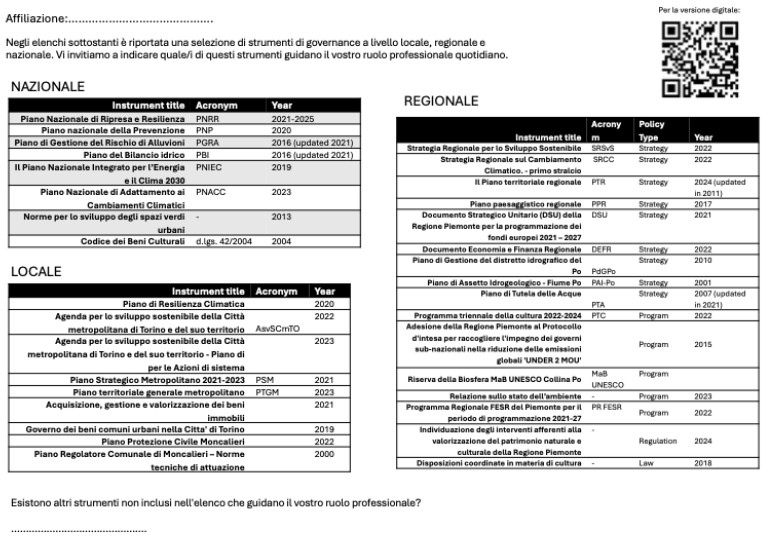
Findings from the AGREE project reveal a persistent fragmentation between heritage and climate governance. While both domains are increasingly present within policy agendas, their integration remains limited and often symbolic rather than operational. Cultural heritage is frequently acknowledged as a valuable asset to be protected, but rarely as an active component of adaptation strategies. This results in a disconnect between how heritage is framed conceptually and how it is governed in practice.
Comparative analysis across case studies highlights that governance effectiveness depends strongly on coordination mechanisms between sectors and scales. In contexts where heritage is embedded within planning and risk management frameworks, more adaptive and anticipatory approaches emerge. However, institutional silos, regulatory asymmetries, and discontinuities between local and national levels continue to limit the implementation of integrated strategies.
Technological sphere: Understanding risk through data and historical analysis
The technological frame addresses how risk is understood, represented, and analyzed through data, spatial tools, and historical investigation. Within AGREE, this involves combining existing datasets (e.g. Copernicus, local GIS platforms) with archival research and post-disaster analysis to reconstruct the evolution of risk over time. Figure 2 illustrates the comparative spatial analysis of the two case studies, Moncalieri and Hull, juxtaposing heterogeneous datasets to highlight how different governance contexts and data frameworks shape the representation and understanding of flood risk and heritage distribution.
Figure 2. Comparative spatial visualization of the AGREE case studies in Moncalieri (left) and Hull (right), integrating multiple datasets related to flood risk, land use, and cultural heritage assets.
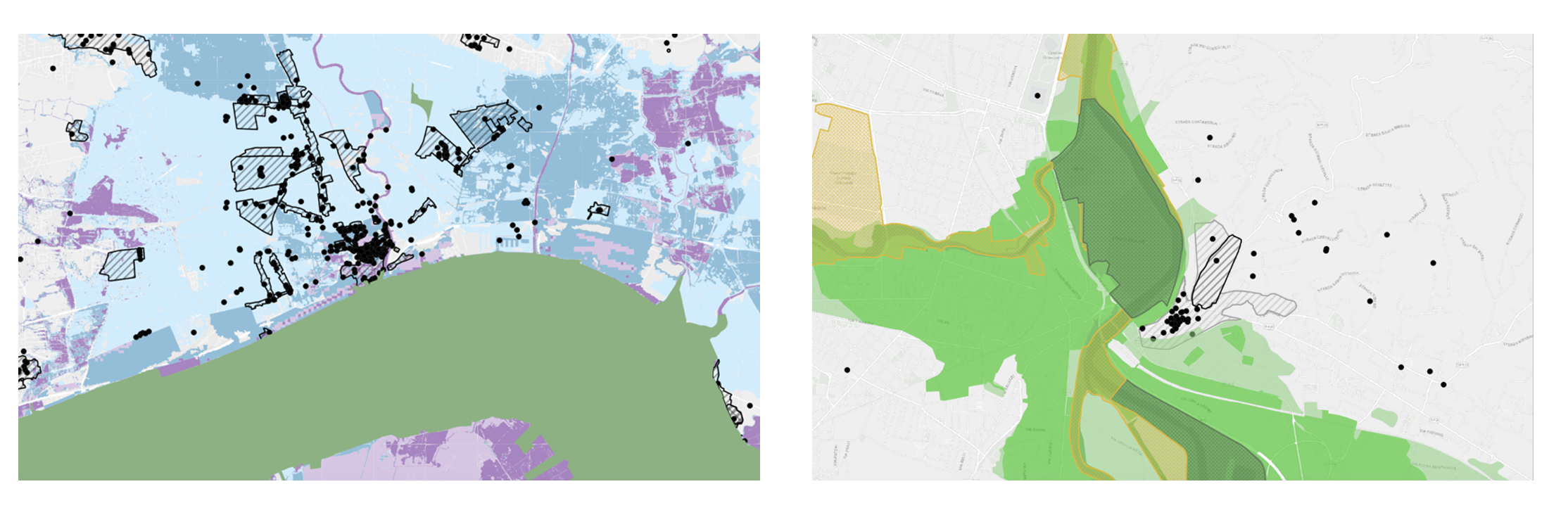
The juxtaposition highlights differences in data availability, mapping approaches, and governance frameworks, revealing how diverse analytical contexts influence the interpretation of risk and the spatial relationship between heritage and vulnerable areas.
© Mesut Dinler. Different national datasets are brought together in QGIS over the basemap of Open Street Map.
A key outcome of this approach is the recognition that flood risk is not an isolated event but the result of long-term socio-environmental and infrastructural transformations. As demonstrated in the Moncalieri case, risk emerges from the cumulative effects of urbanization, river engineering, and infrastructural development, which progressively shape exposure and vulnerability.
The integration of GIS-based spatial analysis with historical data enables a multi-scalar reading of urban landscapes, linking event-based analysis with long-term territorial processes. This aligns with the longue durée perspective, which highlights how risk is historically constructed through planning decisions, energy transitions, and environmental modifications.
The AGREE dataset plays a crucial role in this framework by consolidating spatial, environmental, and policy-related data into a unified platform, thereby supporting comparative analysis across case studies (Dinler et al., 2025). Through this integration, historic urban landscapes are reinterpreted as “laboratories” of adaptation, where past responses to flooding provide insights for future strategies.
Stakeholders, actors, and knowledge exchange
The social frame focuses on the role of stakeholders in shaping governance processes and adaptive capacity. It examines how different actors—public authorities, technical experts, local communities, and private stakeholders—interact within decision-making processes related to heritage and climate adaptation.
Findings from the AGREE project highlight that governance is not only a matter of institutional arrangements but also of social and institutional dynamics, knowledge exchange, human communication, and participation. One of the key challenges identified is the fragmentation of actors, where multiple stakeholders operate with different priorities, languages, and levels of influence.
However, the project also demonstrates that participatory and cross-sectoral approaches can foster more effective governance. Workshops, seminars, and stakeholder engagement activities reveal the importance of integrating technical knowledge with local and experiential knowledge. As an example, Figure 3 presents the program of one of the AGREE seminars conducted with stakeholders from the Moncalieri case, illustrating the diversity of stakeholders involved and the structured dialogue across institutional, technical, and community perspectives in addressing climate adaptation through cultural heritage.
Figure 3. Programme of the AGREE seminar “Governance del Patrimonio per Resilienza e Adattamento” (Politecnico di Torino, 6 March 2025),
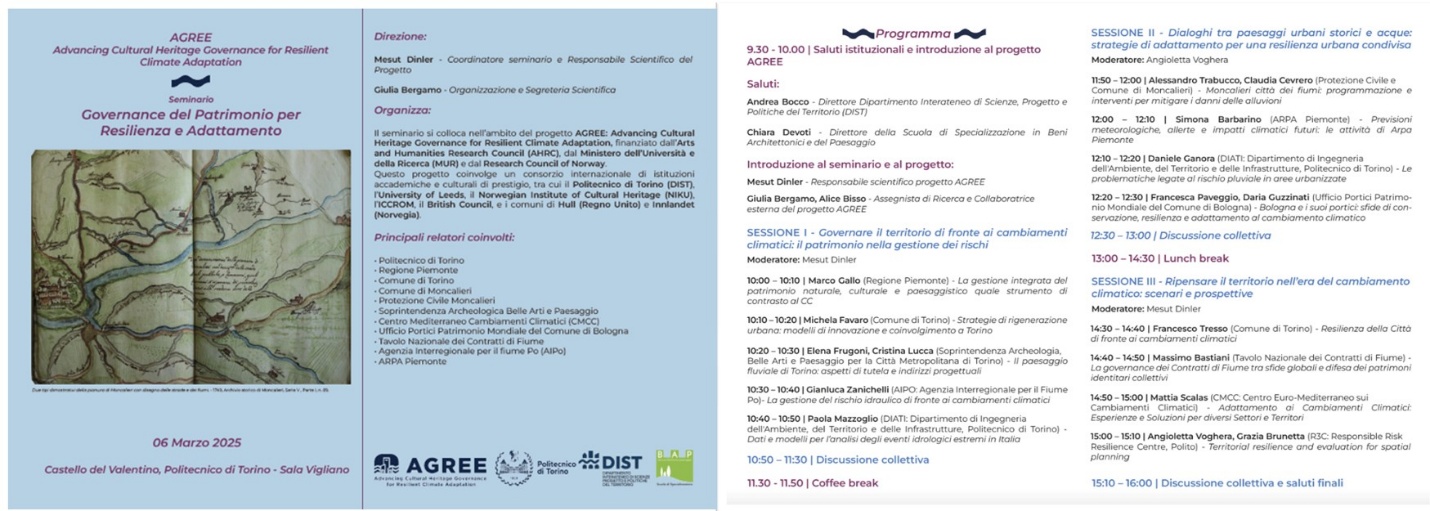
It shows the range of participating actors—including public authorities, research institutions, and practitioners—and the thematic sessions dedicated to climate change, risk management, and heritage governance. The program reflects the project’s participatory and cross-sectoral approach, fostering knowledge exchange and collaborative dialogue across multiple governance levels.
In particular, community memory of past flood events emerges as a crucial resource for understanding risk and informing adaptive practices. As shown in the Moncalieri case, local actors had already identified vulnerabilities prior to the 2000 flood, yet their knowledge was not effectively integrated into decision-making processes (Dinler et al., 2026).
Ultimately, the AGREE project highlights that effective climate adaptation requires not only technical and institutional innovation but also the construction of shared languages and collaborative frameworks among stakeholders. Knowledge exchange thus becomes a central mechanism for bridging governance gaps and enabling more inclusive and adaptive approaches.
Conclusion: Towards integrated heritage governance for climate adaptation
This paper has explored the role of cultural heritage governance in shaping climate adaptation processes, with a specific focus on flood resilience in historic urban landscapes. Drawing on insights from the AGREE project, it has demonstrated that disasters are not merely the result of natural hazards but are produced through the interaction of environmental processes, governance systems, and long-term territorial transformations.
By combining policy analysis, spatial data, and stakeholder perspectives, the study highlights the persistent fragmentation between heritage, planning, and climate governance. Despite increasing recognition of the importance of integrated approaches, heritage remains insufficiently embedded within adaptation strategies, limiting its potential contribution to resilience.
At the same time, the findings show that cultural heritage can act as a critical resource for climate adaptation. Through historical knowledge, spatial structures, and community memory, historic urban landscapes provide insights into past adaptive practices and support the development of context-specific responses to environmental change. The comparative analysis of Moncalieri and Hull further demonstrates how different governance frameworks and data environments shape the understanding and management of risk.
Ultimately, the paper argues for a shift toward more integrated, multi-scalar, and participatory governance models. The HUL approach offers a valuable framework for advancing this transition, enabling the alignment of heritage, climate, and planning policies. Addressing climate challenges in historic cities will require not only technical solutions but also the capacity to bridge disciplinary, institutional, and cultural divides through shared knowledge and collaborative action.
*
|
Author’s disclosure of the use of generative AI |
|||
|
YES |
NO |
Details |
|
|
Writing and argumentation |
X |
Use not permitted in Cahiers ESPI2R |
|
|
Information retrieval and literature review |
X |
||
|
Rephrasing |
X |
||
|
Spelling and/or grammar correction |
X |
||
|
Summarization and/or keyword generation |
X |
||
|
Image and video generation |
X |
Use not permitted in Cahiers ESPI2R |
|
|
Coding and programming |
X |
||