
Introduction
Six decades ago, the term “Bruxellisation” was coined to describe the destruction suffered by several historic European city centers during the reconstruction euphoria of the post-war period (Comhaire, 2012; Leloutre, 2022). Abbé Grégoire, who introduced the term “vandalism” (Marot, 1980) during the French Revolution, famously declared that he had “invented the word to kill the thing” (Abbé Grégoire, 1840/1989). It refers to the profound urban upheavals experienced by cities handed over to developers at the expense of their inhabitants’ living environment, under the guise of necessary “modernisation.” The term “Bruxellisation” (verbrusseling) was undoubtedly coined for similar reasons.
We are familiar with the mechanisms through which such processes unfold. In Brussels, developers, faced with opposition from the local population, acquired several blocks of buildings and deliberately left them abandoned. These buildings were allowed to deteriorate until the last residents had fled and the building permit was finally granted. What appeared to be a neutral planning procedure was, in practice, a gradual strategy of displacement.
However, Brussels also witnessed organised resistance against “Bruxellisation.” Many still remember the famous “Battle of the Marolles” (Martens, 2009; Comhaire, 2012): in June 1969, residents of the Marolles district, threatened with expropriation as part of plans to expand the Palace of Justice, mobilised collectively. Organised into the “Comité général d’action des Marolles” (Marolles General Action Committee), they succeeded in having the project abandoned. To celebrate their victory, the residents organised a symbolic event to “bury the Developer, his wife Bureaucracy, and their child Expropriation.” A street plaque can still be seen today in the Marolles area, remembering the “battle” on 13 September, 1969 (figure 1). This performative gesture, organized by the local inhabitants, explicitly highlighted the political dimension of urban redevelopment. “Bruxellisation” has affected numerous cities across Europe and around the world. In the United States, one of the most emblematic examples is Detroit, where entire sections of the city have been destroyed, in some cases irreversibly (Herstad, 2017).
Figure 1. Battle of the Marolles, September 13, 1969: street plaque in the Marolles area (Brussels)
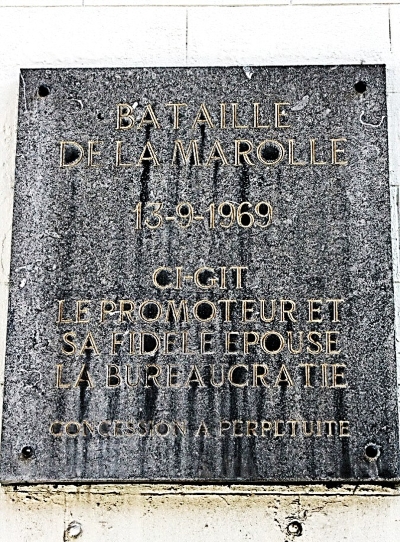
« Ci-git le Promoteur, et sa fidèle épouse la Bureaucratie - Concession à perpétuité » (“Here lies the Developer, and his faithful wife, Bureaucracy — Perpetual concession”)
© Michel wal, Wiki Commons. CC VY-SA 3.0.
Bordeaux also went through phases of systematic demolition, most notably in the Mériadeck neighborhood (Guillaume, 1983). According to some analyses, the destruction of Mériadeck was largely justified by its basis of its negative social reputation. Yet in 1955, the neighborhood was home to approximately 7,500 residents of modest means, and only about 10% of the housing stock was classified as “unsanitary and defective” (Guillaume, 1983), along with units considered overcrowded. Mériadeck was not a neglected district devoid of vitality; rather, it was a neighborhood with complex urban functions, with nearly half of its shops specializing in furniture and related crafts.
Bordeaux provides a particularly clear example of a turning point in the urban heritage paradigm. The first studies proposing the total demolition of Mériadeck date back to 1955, and the decision was formalized by a Bordeaux City Council resolution ratifying the 1960 project. Yet the Malraux Law, which established heritage conservation as a national priority, was passed on August 4, 1962. In 1967, the Bordeaux Secteur sauvegardé, a 150-hectare protected area (Barrère & Cassou-Mounat, 1980; Genty, 2019)—one of the largest in France—was promulgated.
In Bordeaux, as elsewhere, it is therefore possible to identify precisely the moment when urban history shifted toward heritage-based policies. Similar developments occurred in other cities. In the Marais district of Paris, for example, a transition took place from large-scale demolition to comprehensive conservation, culminating in the creation of a Secteur sauvegardé in 1964.
These events are characteristic of the “urban struggles” that took place in different cities in Europe and the United States in the 1960s, the “Golden Years” of radical urban redevelopment. These urban struggles are conflicts that not only take place in the city but also concern the city: they are collective, concerted, and confrontational actions, sometimes illegal, which aim to oppose urban policies orchestrated by the state or public authorities at the local level, while also participating in broader debates (Chatelan, 2014). The vast majority of them took place between the early 1960s and the late 1970s.
In heritage and urban planning, as in any other field, we are all “children of our time.” These turning points must be understood within broader local, national, and international economic and social structures. Such moments often await a major event or an influential political figure capable of formalizing and articulating ongoing transformations. In France, this role was played by André Malraux and his ministry, which, through the creation of Secteurs Sauvegardés (protected sectors), established a new paradigm. In his famous 1962 speech, Malraux reminded us that “The soul of this past is not made up solely of masterpieces; […] in architecture, an isolated masterpiece risks being a dead masterpiece”1 (Malraux, 1962), marking a decisive turning point in French urban history.
The “Stone City” Heritage Paradigm
The 1970s and 1980s confirmed—initially hesitantly and later more decisively—the emergence of the heritage paradigm in urban planning. This perspective now appears largely consensual. Various public and private actors at both local and international levels, agree that urban heritage constitutes a powerful driver of local development, a factor of singularization and distinction in a context of interurban competition, an element of identity construction, and a lever for the tourism economy (Baillie et al., 2014).
I refer to this framework as the “stone city” heritage paradigm. It designates an approach in which urban heritage is defined primarily through its materiality—whether in stone, concrete, or other building materials. Heritage, in this understanding, is essentially tangible and visually legible.
The example of Le Marais in Paris can briefly illustrate this paradigm. The preservation of Le Marais, supported by a Plan de Sauvegarde et de Mise en Valeur (PSMV) initiated in 1964, was—and remains—widely supported and recognized as a successful neighborhood regeneration project. The district has been the subject of a long and uninterrupted preservation effort since that date. Considerable public funds have been invested in the restoration, conservation, and transformation of historic buildings—particularly prestigious aristocratic mansions—into cultural spaces. A curated “culturescape” (Gravari-Barbas, 2017) has thus been produced, contributing to a significant transformation in the appearance of what was formerly a Jewish and industrial neighborhood.
However, this project, producing what Sharon Zukin would call a curated “landscape of power” (Zukin, 2009), has also contributed to the displacement of some of its inhabitants and to the disappearance of its craft activities, thereby radically altering the social composition of the neighborhood. While urban heritage, in its physical form, has been preserved and restored, the same cannot be said for the functions that Le Marais once housed, its social composition (Gravari-Barbas, 2017) or its urban “atmosphere” (Griffero, 2016).
This produces certain urban paradoxes. For example, the façade of a former horse butcher’s shop has been meticulously conserved and restored (figure 2). Yet, there is no longer any place in Le Marais for such a shop, as this is not a product consumed by the new inhabitants of the district. The shop now sells socks from a fashionable Japanese brand at £50 a pair (Mermet & Gravari-Barbas, 2013). The issue here is not the change of function itself—urban functions have always evolved, and cities are inherently dynamic—but rather the gap between the users of former functions and those of the new ones.
Figure 2. The mosaic façade of the former horse butcher shop at the intersection of Vieille-du-Temple and Roi-de-Sicile streets, Le Marais, Paris
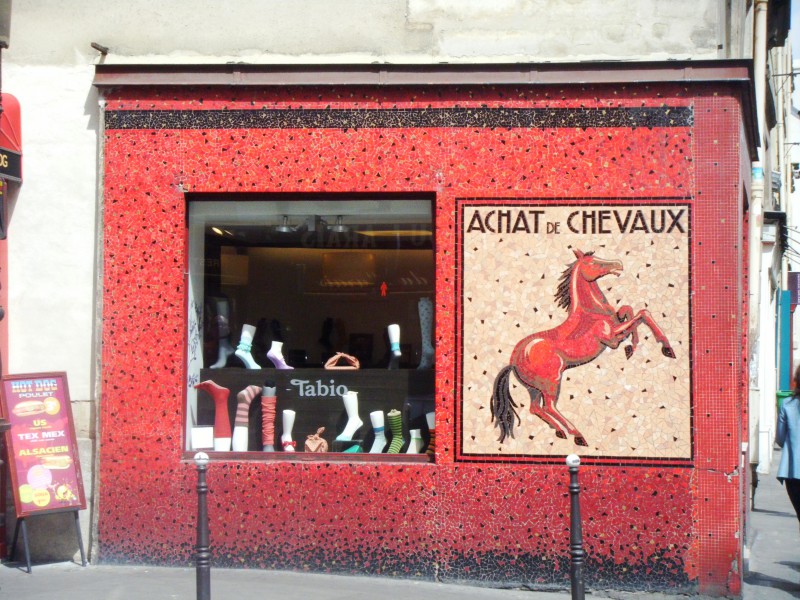
The decoration was created between 1930 and 1946 and follows the color code that specifically identified horse butcher shops, distinguishing them from traditional butcher shops.
© M. Gravari-Barbas.
In Le Marais, public funds have contributed to radically transforming the neighborhood, generating considerable added value that has primarily benefited private owners. In other words, the restoration of heritage using taxpayers’ money—generally hailed as an operation that “saved the Marais”—has simultaneously created the conditions for gentrification, museumification, and touristification (Gravari-Barbas & Guinand, 2017; Gravari-Barbas & Guinand, 2025). Heritage restoration contributes to what Neil Smith famously termed the “revanchist city”—the reoccupation of central urban spaces by middle- and upper-class residents, often at the expense of working-class populations (Smith, 1996).
A second example of the “stone city” heritage paradigm is Covent Garden in London (Christie, 1974). Covent Garden Market was “saved” from destruction through a grassroots movement that enabled “the voices of ordinary people” to participate in debates over the city’s future in an unprecedented manner (Murphy, 2016)2. However, the preservation and subsequent social transformation of Covent Garden was, to quote Murphy, “a Pyrrhic victory, in many ways just as bad as losing the buildings would have been in the first place” (Murphy, 2016, p. 146). In November 1974, Covent Garden was still “a colorful, congested, and vibrant place in the heart of London” (Burguess, 1978, p. 93). The following month, Covent Garden was effectively empty. Warehouses stood deserted; the Floral Hall was abandoned and dark. The market had moved to a new purpose-built site south of the River Thames at Nine Elms, Battersea, and three centuries of tradition in Covent Garden were abruptly broken (Burguess, 1978). Can the safeguarding of Covent Garden’s buildings truly be considered a “happy ending”? In fact, the communities that had constituted Covent Garden were eventually displaced through processes of commercial gentrification.
Beyond these examples in Paris and London, numerous historic neighborhoods and cities across Europe, Asia, and South America have undergone heritage restoration processes that focus almost exclusively on the material aspects of heritage, often neglecting the social impacts of these projects. Even when restoration is technically successful, it produces collateral effects—most notably touristification, museumification, and gentrification (Paiva, 2023).
The researcher Marco D’Eramo coined the concept of “Unescocide” to describe the fate of certain sites listed on the UNESCO World Heritage list. As he writes: “What was once a living torrent, full of shouts and fury, is now safely enclosed in a travel brochure. The death sentence is delivered from an elegant building in Paris—Place Fontenoy, Seventh Arrondissement […]. UNESCO’s ‘World Heritage’ listing is the kiss of death. Once the label is affixed, the city’s life is snuffed out; it is ready for taxidermy” (D’Eramo, 2014). D’Eramo reminds us that the analogy between cultural heritage sites and natural parks is misleading. “Nature reserves are created to multiply the existing fauna and flora, whereas the human fauna of World Heritage cities is forced to flee as the practicalities of daily life become impossible” (D’Eramo, 2014).
The example of Luang Prabang in Laos is often cited as an illustration of heritage destruction carried out with the noblest intentions, and in the name of heritage itself. Its designation as a World Heritage Site in 1995 led to rapid and largely uncontrolled tourist development. International investment stimulated property speculation, with residents leaving and their houses being converted into hotels or restaurants. Luang Prabang is now likened to a “tropical Saint-Tropez” and even to “cultural Disneylandization” (Philip, 2010). “The accelerated rejuvenation caused by the influx of staff for hotels, restaurants, bars, and souvenir shops is thus combined with a loss of identity for the city, now abandoned, especially in the historic peninsula, by its original inhabitants” (Philip, 2010).
In different contexts around the world, the quasi-consensual acceptance of the importance of preserving material urban heritage discussed above (the “stone city” heritage paradigm) often leads to the reduction of heritage preservation to what is commonly referred to as “facadism” (Richards, 1994; Chen & Zhu, 2024). This has become a routine spectacle in contemporary cities: buildings are gutted internally while their façades are preserved, sometimes to almost comical proportions. The exterior remains as an image, while the substance behind it is entirely transformed.
Façadism, as it is practiced today, remains controversial (Kyriazi, 2019; Morgan, 2023; Plevoets, 2021). Some architects and heritage theorists, such as David Lowenthal (1998, 1999), have at times advocated façadism as a pragmatic way of preserving the image of old buildings and thereby maintaining a sense of urban continuity and identity. Others have defended the opposite position, arguing that such practices empty heritage of meaning and reduce it to mere surface aesthetics.
Figure 3. Façadism in Bordeaux
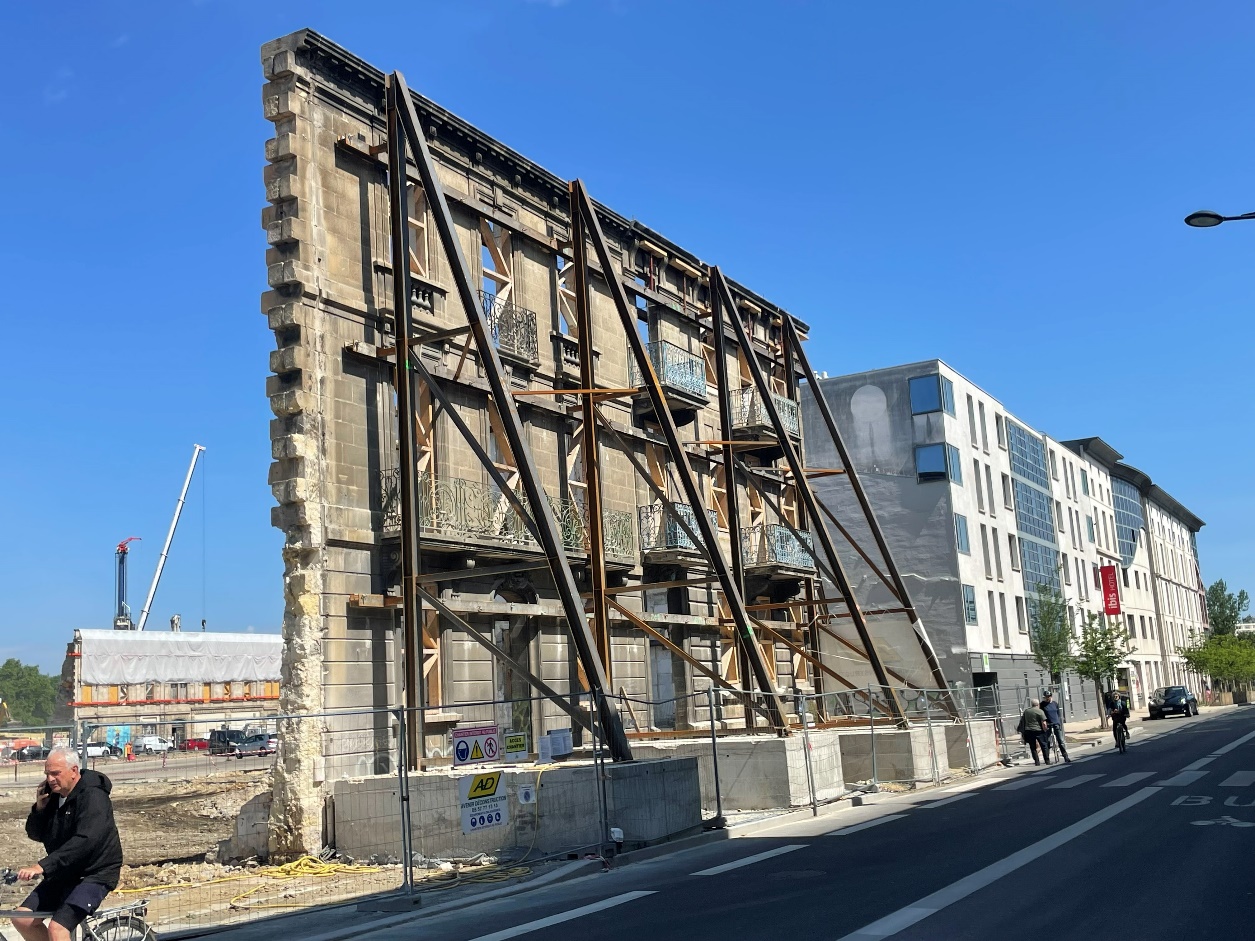
Part of the façade of a building, which will be integrated into a large-scale urban development programme, Bordeaux Saint-Jean aims to create a lively, multifaceted mixed-use neighborhood between Saint-Jean station and the Garonne River. Marketed as a “true ‘urban haute couture’ operation,” the Apsys project is demolishing and rebuilding 4 hectares on the edge of the urban area listed by UNESCO.
© M. Gravari-Barbas, May 2025.
The role played by official state heritage regulations must also be examined critically. In France, a country with a long and strong tradition of heritage protection, the classification of facades and roofs alone is often decided by architects working within the Historic Monuments administration. The policy of protected areas has frequently set the tone, focusing primarily on exterior aesthetics and the immediate surroundings of monuments. Contemporary cities are increasingly reliant on façade, images, and relics to promote themselves. The historic built environment is co-opted into marketing strategies, becoming a visual asset mobilized to enhance attractiveness and competitiveness.
The conservation of the physical components of heritage has intensified since the mid-1980s, within a broader context of neoliberal urban policies that channel public and private resources into specific areas—business districts, flagship projects, regeneration zones—in the hope of generating so-called “trickle-down” effects (Harvey, 1993, p. 29). For geographer David Harvey, such initiatives have triggered “a veritable deluge of creative destruction” in urban environments around the world (Harvey, 1993, 2012). Harvey’s theory of accumulation by dispossession becomes central, since it allows us to understand displacement not as an incidental result but as a structural tool. Heritage-led regeneration often functions as a mechanism for value capture: public investment increases land values, and private actors appropriate the gains.
In this process, heritage is not merely a passive “pawn” within capitalist restructuring; it is deeply implicated in the transformation—and at times the erosion—of urban life. Heritage becomes both a resource and a justification within broader strategies of urban competitiveness.
We are well aware of the importance of heritage images in contemporary cities. Global competition among cities vying for investment, particularly in the real estate sector, requires them to distinguish themselves by highlighting lifestyle, design, and culture. Built heritage thus becomes a key differentiating factor, distinguishing one city from others competing to attract a mobile population at national and global scales—and, crucially, the capital that accompanies it. In the transition from an industrial to a postindustrial economy, heritage—and especially the image of heritage—becomes an essential tool of urban marketing. This quasi-fetishistic understanding of heritage, reduced to its material and visual dimensions, sometimes reaches anecdotal extremes. Marx’s notion of commodity fetishism offers a useful lens. In fetishism, social relations between people appear as relations between things (Marx, 1867). In facadism, the complex social history of a building is reduced to its aesthetic surface. The façade circulates as a signifier of authenticity, while the social relations that produce it are erased.
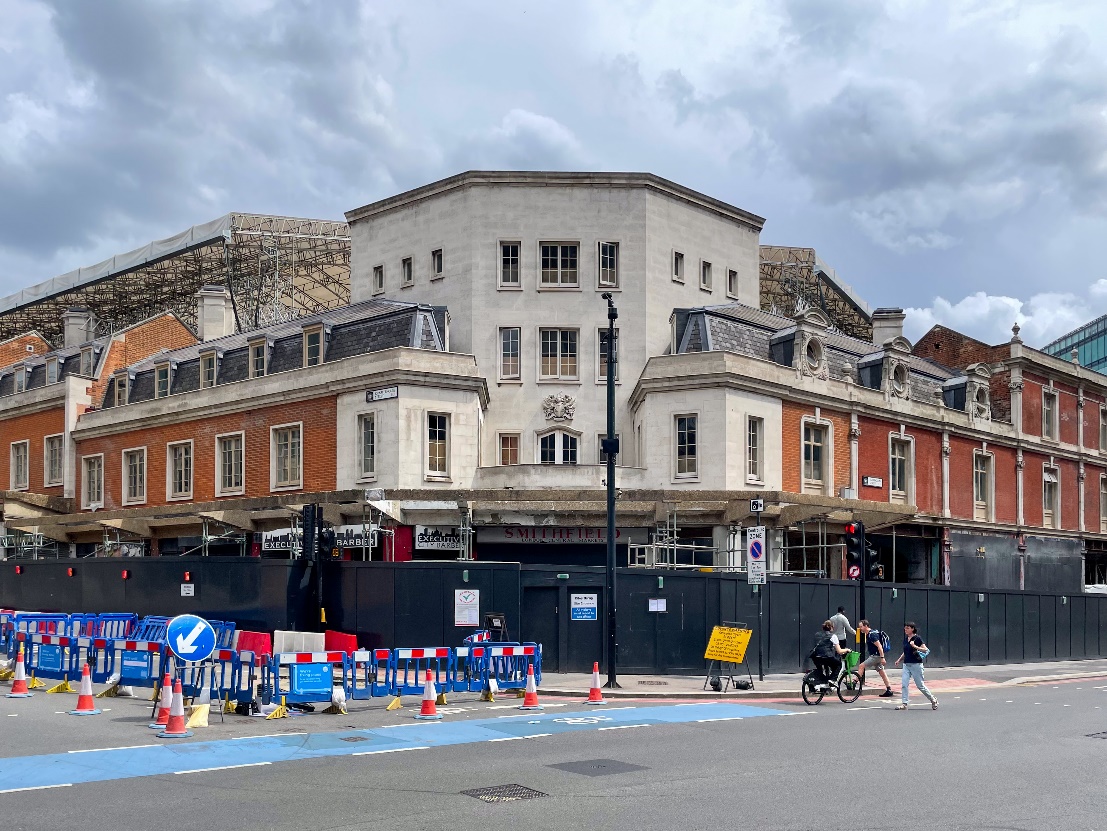
Two examples from London illustrate this process of decontextualisation through facadism. The first concerns the General Market at Smithfield. In November 2025, the City of London Corporation announced that the market would close after almost 900 years of trading and that the Museum of London would relocate to its buildings (Hanlon, 2025). The repurposed structure has been redesigned to house part of the museum’s six-million-object collection within the fabric of the former market itself. The building becomes part of the curated narrative. As reported by The Guardian, the museum’s new acquisitions include “a row of derelict shops… a giant Edwardian gas burner, an entire street, and a working train line”—all integral parts of the Smithfield complex (Figure 4). The relocation of the Museum of London to Smithfield effectively collapses the distinction between the image of the city—what one might expect to see inside a museum—and the lived built environment that structures everyday urban life (Kafka, 2018). The structure of Smithfield Market thus takes on a new significance as it is repurposed as the Museum of London. Its architectural elements become historical artifacts. At the same time, the “sensory choreography” of the neighborhood (Montserrat Degen & Butler, 2025), created by shops, markets, cafes, and the everyday life of its streets, was severely altered. “Cities need more than just sanitized, commodified and static zones that act as Instagram backdrops” (Montserrat Degen & Butler, 2025).
Figure 4. Smithfield Market being refurbished in 2023
© Mike Peel, Wikipedia Commons. CC-BY-SA-4.0.
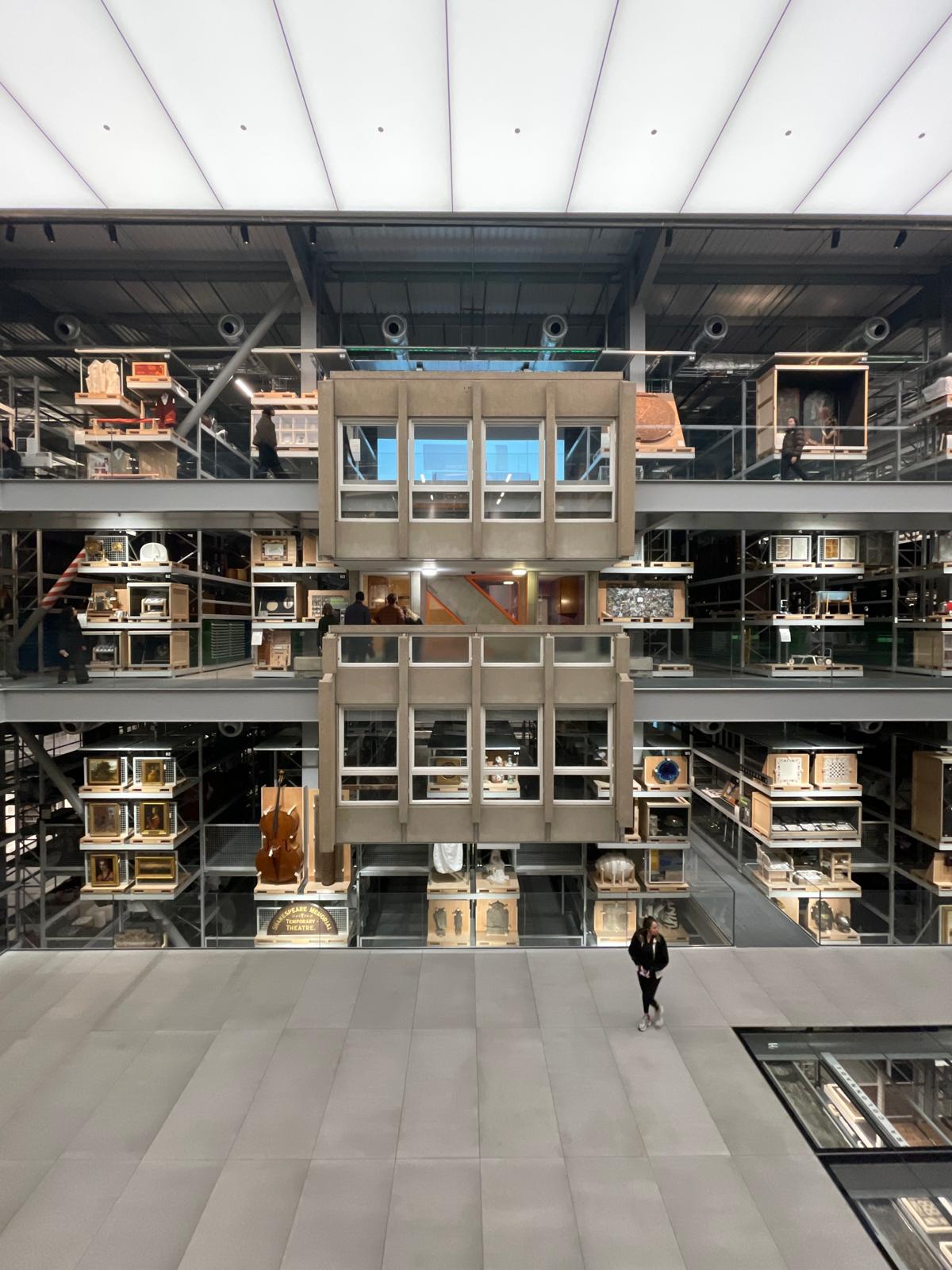
The second example is even more representative of this fetishistic understanding of heritage. In 2017, Robin Hood Gardens—a Brutalist housing estate in East London, completed in 1972 by two of the most prominent British architects, Alison and Peter Smithson—was demolished to make way for Blackwall Reach, a luxury property development. On the eve of its demolition, the Victoria and Albert Museum acquired a three-story section of one façade, together with the interior fittings of two flats3 (figure 4). The acquired fragment measures 8.8 meters high, 5.5 meters wide, and 8 meters deep. It includes the interiors of a maisonette flat, sections of a concrete stairway, and part of an elevated walkway known as the “streets in the sky,” originally designed to foster neighborly interaction. This acquisition constituted one of the most unusual property transactions in the Museum’s history (Brown, 2017). The V&A’s act of “preservation” has been described as a fetishization of working-class ways of living (Pritchard, 2017a) and the social cleansing and gentrification of Robin Hood Gardens as “artwashing” (Pritchard, 2017b, in Sterling, 2020).
The removal of a fragment of social housing into a museum setting and its exhibition at the Venice Biennale (Bennes, 2018) detach architectural form from its social context. This case raises fundamental questions concerning heritage preservation. The Twentieth Century Society, an NGO campaigning for the protection of outstanding twentieth-century buildings, may have been correct in suggesting that refurbishment could have saved the estate architecturally4. However, would such preservation have been preferable if it entailed the eviction of all council tenants and their replacement by affluent residents as part of a luxury redevelopment? If not, would the protection of a specific “way of life”—working-class, ethnically diverse, family-oriented—have been more desirable from a heritage perspective than the preservation of the buildings in situ? Furthermore, if residents themselves voted in favor of wholesale demolition and rebuilding, should heritage advocates have supported or hindered that decision-making process?
Figure 5. Fragment of Robin Hood Gardens façade (by Alison and Peter Smithson) exposed at V&A Storehouse, London
© M. Gravari-Barbas, January 2026.
The “People’s City” Heritage Paradigm
Within urban heritage debates, the dilemma of “stones versus people” emerged clearly with the first major restoration projects of the 1960s and 1970s. The conservation and restoration of historic centers were celebrated as victories following the violent urban renewal projects of the post-World War II period, which had resulted in the erasure of vast portions of cities. Although respectful of the built fabric, these heritage projects often produce new forms of exclusion. The restored urban setting made attractive to newcomers—both residents and visitors—was progressively emptied of its former inhabitants.
The evaluation of urban heritage policies (are they beneficial? Are they harmful?) depends fundamentally on how heritage is defined. Is heritage “stone”? Is it “people”? Is it beautiful architecture? Or is it a way of life? Can a restoration that results in the displacement of long-standing residents still be considered successful? Additional criteria must therefore be introduced when assessing interventions in historic urban contexts. The intangible and immaterial dimensions of urban life—local social networks, local commerce, demographic composition, neighborhood atmosphere—must be taken into account alongside architectural conservation (Smith, 2010; Bandarin & van Oers, 2014). Rather than focusing exclusively on “stones,” our attention must also be directed toward the differential agents of change that constantly reshape our living environment (Matthes, 2018).
If we look beyond heritage as an object and instead focus on the consequences of urban change—changes that directly impact heritage—the question that immediately arises is: who or what produces this change, and what are its effects? When we shift perspective in this way, a different set of “threats” emerges. These threats are more closely linked to the social worlds of heritage, which are often particularly vulnerable. Even if heritage in its material form is not directly undermined by destruction, the idea of democratic and inclusive heritage can be profoundly threatened by processes of appropriation and exclusion, which may be economically or socially violent.
This leads us to introduce a paradigm that extends the “stone city” heritage model: the “people city” heritage, which takes a holistic approach to considering the buildings and the urban life they shelter. This shift is, above all, semantic. It is no longer merely a question of protecting the materiality or aesthetics of the built environment, but rather of safeguarding its social substance—the demographic composition of neighborhoods and everything that accompanies it: specific types of commerce, forms of sociability, and neighborhood atmospheres.
However, the tools available to achieve this objective remain limited. In Le Marais, for example, the former mayor of the 4th arrondissement reportedly purchased the last fishmonger to preserve a function considered essential to the neighborhood’s identity. In the absence of adequate urban instruments capable of preserving functions rather than merely façades, direct property acquisition becomes one of the few available strategies. In Paris, a property company named “Rez-de-Ville,” a subsidiary of PariSudam, was established to manage and control ground-floor retail spaces. PariSudam’s mission includes preserving traditional businesses such as butchers, bakers, and booksellers, fostering commercial diversity, and reducing vacancy rates.
This initiative was created in response to the observation that commercial activities are often imposed on neighborhoods and that ground-floor premises are frequently controlled by investors seeking rapid returns, which inevitably results in high rents. This dynamic leads to an ove-representation of businesses capable of paying such rents—bank branches, insurance companies, multinational retailers—at the expense of small independent shops whose economic models cannot sustain similar costs.
Cities therefore need to develop systems of equalization (péréquation), adapting rent levels according to the nature of commercial activities. Such mechanisms can serve as effective levers for intervention and allow municipal action to be structured coherently within broader urban policy objectives.
More generally, urban planning instruments such as the PLU in France (plan local d’urbanisme) can be used to safeguard certain types of commerce—particularly food and everyday shops, which are among the most vulnerable, given the fact that they generate limited added value. The PLU regulations stipulate, for example, that certain retail and craft businesses must be strictly protected and reserved exclusively for specific activities. In the case of enhanced protection, a craft business can only be replaced by another craft business, and a retail business can be converted either to continue its commercial activity or to establish a craft business. However, within a neoliberal economic context, characterized by free trade and strong property rights, such tools have limited reach. Even mixed public-private companies such as SEMAEST5 in Paris, which possess significant capital for acquiring premises, face structural constraints. The financial capacity of cities to purchase properties in order to preserve specific functions remains limited.
The “Frugal City” Heritage Paradigm
In recent years, climate change and climate emergencies have introduced yet another paradigm. The “stone city heritage” paradigm (established in the 1960s and 1970s) and the “people’s city” heritage paradigm (which has often struggled to be integrated into the stone paradigm, at times appearing almost antithetical to it) must now contend with environmental issues.
This new paradigm is based on the recognition that all buildings—whether considered beautiful or unattractive, heritage or non-heritage—carry a carbon footprint. Their demolition and reconstruction therefore raise fundamental environmental questions.
As Frédéric Druot, together with Anne Lacaton and Jean-Philippe Vassal, stated: “Never resort to demolition, never remove or replace anything, always make additions, transform and re-use” (Druot et al., quoted in Druot, 2009). These words open the report commissioned by the then French Ministry of Culture, Jean-Jacques Aillagon, who sought to explore alternatives to the systematic demolition of post-war mass housing estates. This request reflected the minister’s discomfort with the enthusiastic adoption of demolition as the primary solution to large housing estates problems by the French Ministry for Urban Affairs. The latter had established the Agence nationale pour la renovation urbaine (ANRU, “National Agency for Urban Renovation”) as the central administrative and funding authority for demolition and reconstruction projects. Developers had already submitted numerous proposals, attracted by new funding streams. As Druot has emphasised, the two ministries never seriously discussed these divergent approaches, and the Ministry of Town and Cities did not engage with the more socially and environmentally oriented alternatives proposed by the Ministry of Culture.
The idea of avoiding demolition was not motivated by nostalgia or exaggerated reverence for history, nor by the consideration of these buildings as heritage sites. Non-demolition became a strategic position. “Ne pas démolir est une stratégie”6 was the title of a public lecture organized at Arc-en-Rêve, addressing the legacy of large housing estates, housing shortages, and proposed demolition plans in the Saige neighborhood of Pessac. “Preserve and transform” is not conceived as an exceptional measure reserved for listed heritage buildings, but as a comprehensive urban strategy. Taking into account embodied carbon, demolition waste and social costs, this approach aligns with what Rem Koolhaas has described as the “strategy of suspending judgment” (Koolhass, 1978). Understood as an ethic of perception, this strategy allows architecture to engage with reality rather than suppress it. It broadens the scope of architectural action in contexts that may initially appear hopeless.
These positions are not entirely new. However, their consolidation within contemporary discourse is reshaping approaches to urban design as well as to the understanding of heritage. Many architects now advocate the renovation and adaptation of existing structures as a responsible alternative to demolition. Philippe Madec’s propositions in Mieux avec moins (2021) and Commune frugale (2022) articulate this perspective clearly.
Conclusions
Let us return to the question of heritage—or rather, to what we consider heritage at different moments in urban history since the 1960s (without revisiting earlier polemics from Baron Haussmann to Victor Hugo and Guerre aux démolisseurs (1832), though they are relevant). Today, heritage is no longer confined solely to beautiful stones and high-quality architecture—although these remain important. Nor is it only about reconciling architectural preservation with the well-being of residents—although that remains an essential objective. We increasingly consider the built environment in all its dimensions as heritage: existing buildings, their material histories, their social uses, and their carbon footprint.
This text has sought to highlight three overlapping heritage paradigms: that of the stone city, that of the people’s cities and that of the frugal cities. These paradigms are not mutually exclusive; rather, they intersect, complement each other, or sometimes come into conflict.
Protecting the material, social, and environmental values of contemporaries cities is an ongoing struggle in a neoliberal economic context. This struggle varies in terms of existing tools, regulations, and institutional bodies. We possess the legal and technical instruments necessary to protect tangible heritage within the stone paradigm. When protection fails—and unfortunately it often does—it is mostly due to insufficient funding or a lack of political will rather than absence of an existing framework. Preserving intangible heritage in urban contexts may prove to be more complex. Existing mechanisms are insufficient and are heavily dependent on the political orientation of the local governments. Within neoliberal economic frameworks, they are often difficult to implement. Such preservation requires strong regulatory intervention, political courage, and significant resources.
A clear divide persists between tangible and intangible heritage protection. The conservation of tangible heritage—particularly when reduced to façadism—is easily integrated into market logic. The financial “sacrifices” involved are often offset by the added value generated through heritage branding. Historic fragments can function as a “supplement to the soul” of otherwise standardized real estate projects aimed at wealthier newcomers. A heritage facade can represent a commercial advantage. This is not the case, for intangible heritage, which involves maintaining everyday functions and existing communities. Such objectives are far less compatible with speculative investment. Environmental heritage and the commitment to non-demolition further complicate matters. The architectural profession itself remains divided between environmentally responsible adaptation and the continued appeal of large-scale demolition and reconstruction. In urban contexts characterised by multiple stakeholders, these questions are inherently political. Changes in municipal leadership can result in the reconsideration of previously approved projects, as has occurred in Bordeaux and elsewhere. The balance between public and private actors remains central. It largely determines how cities are shaped today—and how the heritage city is built, erased, and rebuilt.
*
|
Author’s disclosure of the use of generative AI |
|||
|
YES |
NO |
Details |
|
|
Writing and argumentation |
X |
Use not permitted in Cahiers ESPI2R |
|
|
Information retrieval and literature review |
X |
||
|
Rephrasing |
X |
||
|
Spelling and/or grammar correction |
X |
||
|
Summarization and/or keyword generation |
X |
||
|
Image and video generation |
X |
Use not permitted in Cahiers ESPI2R |
|
|
Coding and programming |
X |
||