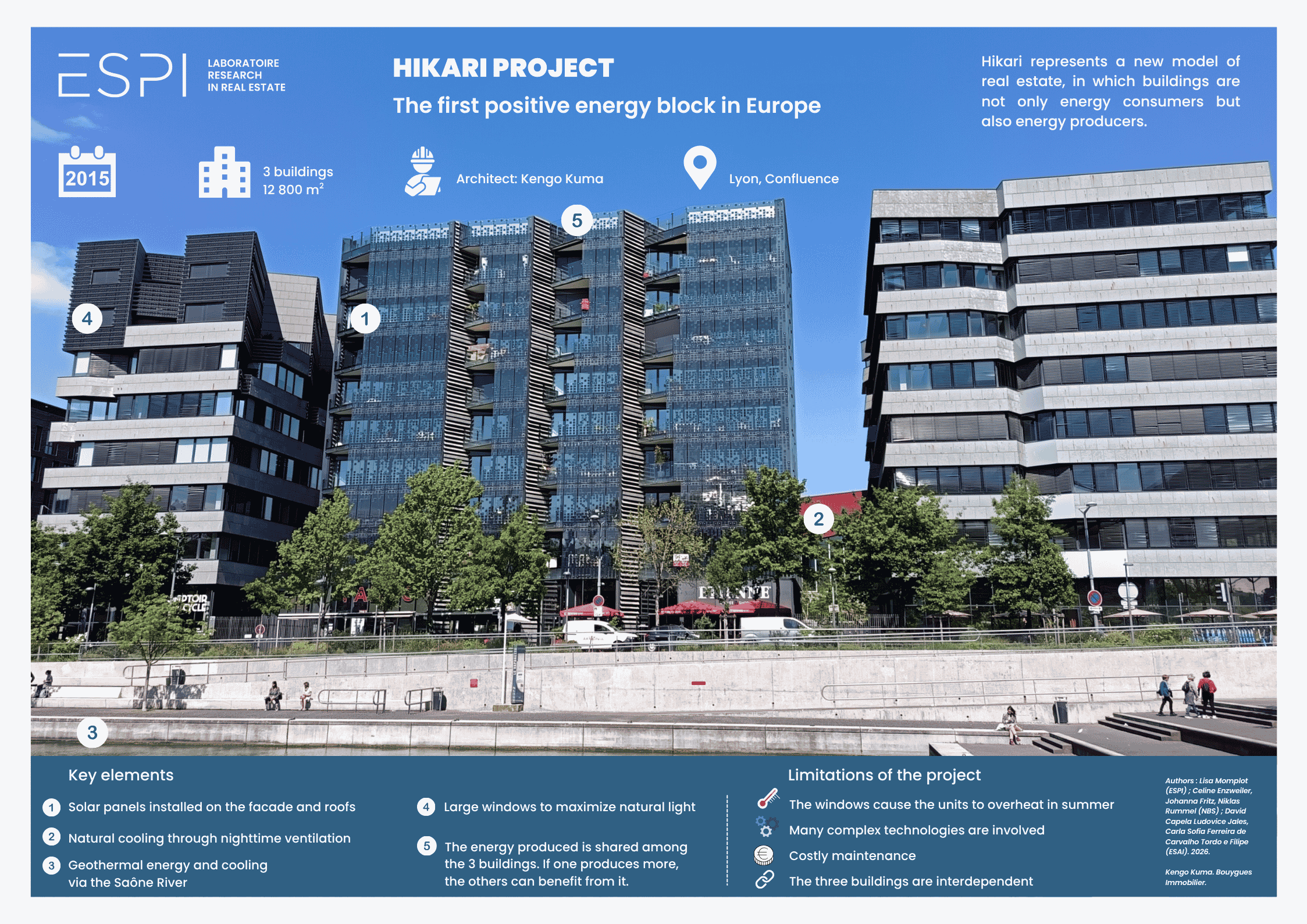
A block of three buildings in Lyon Confluence
Hikari is a mixed-use complex located in Lyon (Confluence district), designed by Kengo Kuma between 2012 and 2015. Covering approximately 12,800 m² across three interconnected buildings, it brings together housing, offices, and retail spaces. It is recognized as the first positive energy urban block in Europe, meaning it produces more energy than it consumes for electricity, heating, and cooling. The buildings are designed to act as active energy producers.
Climate-friendly energy
The project relies on a combination of climate-friendly energy systems. Photovoltaic panels are installed on the roofs and façades, while solar glass façades generate electricity and regulate daylight. Energy production is further supported by combined heat and power systems using rapeseed oil, geothermal energy, and cooling drawn from the Saône River. This hybrid approach integrates multiple renewable sources.
Energy efficiency through passive design
Energy efficiency is also achieved through passive design strategies. The bioclimatic architecture maximizes solar gain and enhances natural daylight through the building form. Natural cooling is supported by night ventilation, while heat recovery systems capture energy from ventilation air and wastewater. Rather than relying on overly complex technologies, the design emphasizes natural processes.
Energy management & system integration
Energy management plays a central role in the project. The goal is to enable local production, storage, and distribution of energy across the site. The mixed-use program helps balance energy demand between day and night uses, optimizing overall load management. Photovoltaic systems are fully integrated into the façades, ensuring both functional and architectural coherence.
Key messages
Overall, Hikari stands as a flagship for sustainable urban development and a model for future positive energy districts. While solar energy is a key component, it is not the only source. The project demonstrates that simplicity is not a limitation, but a smarter and more sustainable approach to urban design.
Limitations of the project
The poster also highlights some limitations of the project, such as overheating caused by large windows and the need for complex technologies and costly maintenance. Moreover, the three buildings are interdependent.
Téléchargez le poster Hikari project: the first positive energy block in Europe (clic)